Disputes with Government Agencies in Kazakhstan in 2026: How a Business Can Challenge a Decision
11.07.2026
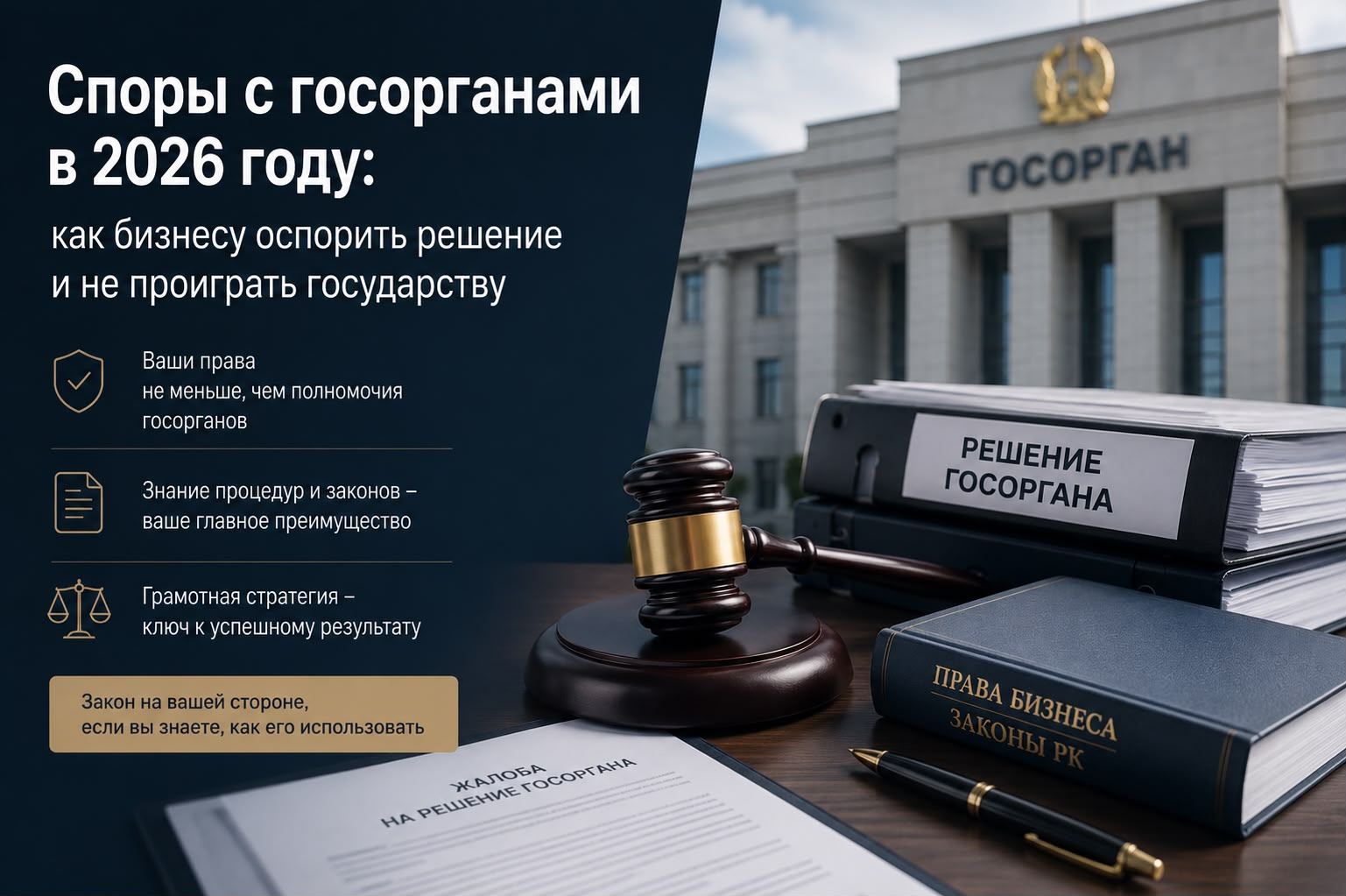
Additional tax assessments after an audit, a refused licence, an order from a supervisory authority, a rejection in public procurement — sooner or later almost every business in Kazakhstan receives a decision from a government agency that hurts it. The law gives businesses strong tools to defend themselves, but they only work if the procedure is followed.
Here is how disputes with government agencies work under the Administrative Procedural and Process Code (APPC), which deadlines are critical, who has to prove what in court and where businesses most often go wrong.
The 30-second summary
A decision, action or inaction of a government agency is, as a rule, first challenged by an administrative complaint and only then in an administrative court (Art. 91(5) APPC). The complaint is filed through the agency whose decision is challenged, and the higher agency considers it. The APPC has been in force since 1 July 2021, and in court it favours the private party on the key point: the agency itself has to prove that its burdensome decision is lawful (Art. 129).
- 3 months to file a complaint from the day you learned of the decision; 6 months if the decision does not explain how to appeal it (Art. 92);
- 20 working days to consider the complaint, with no extension unless a law provides otherwise (Art. 99);
- 1 month to file a lawsuit (Art. 136).
This is general information, not legal advice on your specific case. We checked the provisions against the text of the APPC, linked at the end of the article. It is best to show the decision in your specific dispute to a lawyer.
What a dispute with a government agency is and when it arises
A dispute with a government agency is a public-law conflict between a business (an LLP or a sole entrepreneur) and an administrative body: a decision, action or inaction of the body violates the company’s rights and legitimate interests.
For businesses, in practice, it most often means:
- additional assessments after a tax audit — see our guide “How to Appeal a Tax Audit Notice“;
- a refusal to issue a licence or permit — see our licences and permits page;
- orders from akimats, sanitary, environmental and other supervisory authorities — see our article “Appealing a Regulator’s Order“;
- a refusal or exclusion in public procurement;
- inaction — the body does not answer an application or does not take a required step;
- decisions on land and property matters that affect the business.
These situations are governed by the APPC: both the pre-trial complaint and the hearing of the case in an administrative court. Separate laws add their own rules — for example, the Tax Code for tax audit notices and the Public Procurement Law for procurement results. Fines in administrative offence cases, however, are appealed under the Code of Administrative Offences, not the APPC (Art. 3(4)(1) APPC): they have their own deadlines and their own court.
What works for the business in court
The APPC has been in force since 1 July 2021, and in an administrative court it reverses the familiar logic of “prove you are not guilty”:
- The burden of proof is on the agency. In a claim to annul a decision, the defendant — the body that adopted the burdensome decision — must prove it is lawful (Art. 129(2)(1)). In other types of claims the burden is split between the parties (Art. 129(2)).
- The agency cannot change its reasoning. In court the defendant may rely only on the grounds stated in the decision itself (Art. 129(3)). A poorly reasoned decision is therefore hard to defend.
- What is not proven counts against the party that had to prove it. If a fact on which the outcome depends remains unproven, the consequences fall on the party that bore the burden of proving it (Art. 129(4)).
- The court plays an active role. The court is not limited to the parties’ arguments: if the evidence is insufficient, it gathers evidence on its own initiative (Art. 16, Art. 130(2)).
- Your documents are presumed reliable. Already during the administrative procedure, documents and information you submit are considered reliable until the agency establishes otherwise (Art. 15).
This gives a real chance of winning a dispute with the state — but only if the procedure and deadlines are followed.
The pre-trial complaint: what is mandatory and where to file
Unless a law provides otherwise, you may go to court only after a pre-trial complaint (Art. 91(5) APPC). How it works:
- The complaint is filed with the agency whose decision is challenged (Art. 91(4)). Within three working days it passes the complaint and the case file to the body that considers complaints — the higher agency (Art. 91(3)). If within those three days it fully satisfies the demands itself, it may choose not to forward the complaint.
- If there is no higher agency, the decision is challenged directly in court (Art. 91(6)).
- If the agency stays silent, from the date the deadline expires it is deemed to have refused to adopt the decision or take the action (Art. 91(2)). That refusal can also be challenged.
- The complaint ends in one of these decisions: cancel the act, cancel it and adopt a new one, take the action, reject the complaint, send the case back to the agency to correct violations, or leave the complaint unconsidered (Art. 100). A rejection must be reasoned.
Filing a complaint generally suspends enforcement of the challenged decision. The exceptions are the need to protect the rights of individuals and legal entities or public or state interests, certain acts of the financial regulator, the National Bank and state audit bodies, and other cases set by law (Art. 96). If an exception is applied, the decision itself must give the reasons (Art. 96(2)).
What happens if you file a lawsuit straight away. If the pre-trial procedure is mandatory and can still be used, the court returns the claim (Art. 138(2)(1)). A return on this ground does not prevent you from filing the claim again after the complaint (Art. 138(3)). You do not lose the right to protection, but you lose time, which is costly in disputes with government agencies.
The pre-trial complaint is not a formality. This is the stage where the agency’s violations are recorded and the documents later used in court are collected. How we prepare such complaints is described on our service page “Disputes with government agencies“.
Deadlines you cannot miss
- Complaint — no later than 3 months from the day you learned of the decision or action (inaction) (Art. 92(1)).
- If the decision does not explain how to appeal it — up to 6 months. A decision must state the higher agency, the deadline and the procedure for appeal (Art. 80(5)); if it does not, the complaint deadline is six months (Art. 92(1-1)).
- Consideration of the complaint — 20 working days from registration, unless laws provide otherwise. No extension is allowed except in cases set by law (Art. 99). If there is no decision in time, the complaint is deemed rejected (Art. 100(5)).
- Lawsuit — within 1 month from service of the decision on the complaint or, if there is none, after the time for considering it has expired (Art. 136(1) and (6)). A claim to compel an action — within a month from the day you learned of the action or the deadline for taking it expired (Art. 136(2)).
A complaint deadline missed for a valid reason may be restored by the body considering the complaint (Art. 92(2)); valid reasons are illness, force majeure and other circumstances that made filing impossible. A missed deadline is not in itself a ground for refusing to accept the complaint (Art. 92(3)). The lawsuit deadline is restored by the court (Art. 136(7)), and missing it without a valid reason is a ground for returning the claim with no right to file it again (Art. 136(8), Art. 138(3)). That is the point after which defending yourself in court is no longer possible.
Tax audit notices, public procurement and fines have their own deadlines: for example, a complaint about procurement results must be filed within 3 working days. All of them are in our checklist of appeal deadlines.
Practical tip: start by reading the decision itself. Whether it names the higher agency, the deadline and the procedure for appeal decides whether you have three months or six.
Five types of claims
The APPC lists five types of administrative claims (Art. 131(1)):
| Type of claim | When it is filed | Who proves what |
|---|---|---|
| To annul a decision (Art. 132) | A burdensome decision must be cancelled in whole or in part — for example, an order or an additional assessment | The body that adopted the decision (Art. 129(2)(1)) |
| To compel a decision (Art. 133) | The body must be made to adopt a favourable decision it refused or failed to adopt through inaction — for example, to issue a licence. The refusal does not need to be challenged separately | The body proves the grounds for refusal, the claimant the facts supporting the decision (Art. 129(2)(2)) |
| To compel an action (Art. 134) | The body must take or refrain from an action that is not the adoption of a decision | The body proves the grounds for refusal, the claimant the facts in its favour (Art. 129(2)(3)) |
| For a declaration | A legal relationship must be declared to exist or not, or a decision that is no longer in force must be declared unlawful | The claimant proves the facts of the relationship, the body the lawfulness of its decision (Art. 129(2)(4)) |
| To challenge the legality of a secondary regulation | An agency’s regulation violates the business’s rights | The body that adopted the regulation (Art. 129(2)(5)) |
The type of claim determines both its subject matter and who must prove what, so it is planned in advance. At the same time, the court must help correct formal errors and clarify unclear wording at every stage of the proceedings (Art. 130(1)), so imprecise wording of a demand does not by itself decide the case. How we handle such cases in court is described under representation in court.
Why you need a lawyer before the complaint
Many businesses come to a lawyer only once in court. Yet the key mistakes are made earlier:
- the complaint is filed the wrong way, or the deadline is missed;
- the deadline is counted from the date of the decision instead of the day the business learned of it;
- evidence of violations is not collected at the pre-trial stage;
- the complaint is written as a formality and does not prepare the position for court;
- nobody checks whether enforcement of the decision is suspended while the complaint is pending.
The pre-trial stage builds the evidence the lawsuit later relies on. It can be added to in court, but it is easier to collect it right away.
How KORGAN handles disputes with government agencies
KORGAN has been working since 2014. In disputes with government agencies we:
- assess the situation and the prospects of the case;
- determine the appeal procedure, deadlines and the future type of claim before the first complaint;
- prepare the complaint so that it supports the position in court;
- represent the company before the higher agency and in court — see representation in court;
- seek the cancellation of unlawful decisions, additional assessments and orders.
We tell clients the realistic prospects of the case and run the process so that management is distracted as little as possible. To challenge a government decision, inspection or order, see our service page “Disputes with government agencies in Kazakhstan“.
The first consultation is free.
Phone and WhatsApp: +7 700 500 05 53
Or message us on WhatsApp. Other contacts are on our contacts page.
We checked the provisions against the Administrative Procedural and Process Code of the Republic of Kazakhstan.
Frequently asked questions
Can I go straight to court without a complaint to the higher agency?
As a rule, no: unless a law provides otherwise, you go to court after the pre-trial complaint (Art. 91(5) APPC). Without it the court returns the claim if the complaint can still be filed (Art. 138(2)(1)); you go straight to court if there is no higher agency (Art. 91(6)).
How long do I have to appeal a government decision?
For a complaint — 3 months from the day you learned of the decision, or 6 months if the decision does not explain how to appeal it (Art. 92 APPC). For a lawsuit — a month after the decision on the complaint or after the time for considering it has expired (Art. 136). Deadlines for taxes, procurement and fines are in our checklist of appeal deadlines.
How long does it take to consider a complaint, and can it be extended?
20 working days from registration, unless a law sets otherwise; extension is not allowed except in cases set by law (Art. 99 APPC). If there is no decision in time, the complaint is deemed rejected and you can go to court (Art. 100(5), Art. 136(6)).
Who has to prove that a government decision is lawful?
In a claim to annul a decision — the body that adopted the burdensome decision (Art. 129(2)(1) APPC). It may rely only on the grounds stated in the decision (Art. 129(3)).
Is enforcement of the decision suspended during the appeal?
As a rule, yes: filing a complaint suspends enforcement of the decision (Art. 96 APPC). The exceptions are the need to protect the rights of individuals and legal entities or public or state interests, certain acts of the financial regulator, the National Bank and state audit bodies, and other cases set by law.
What if the deadline has already passed?
The complaint will still be accepted: a missed deadline is not a ground for refusing to accept it, and for a valid reason the deadline is restored on a petition (Art. 92(2)–(3) APPC). A missed lawsuit deadline is restored by the court if the reason is valid (Art. 136(7)).