How to Get a Patent in Kazakhstan: 5 Stages from Idea to Patent
10.11.2026
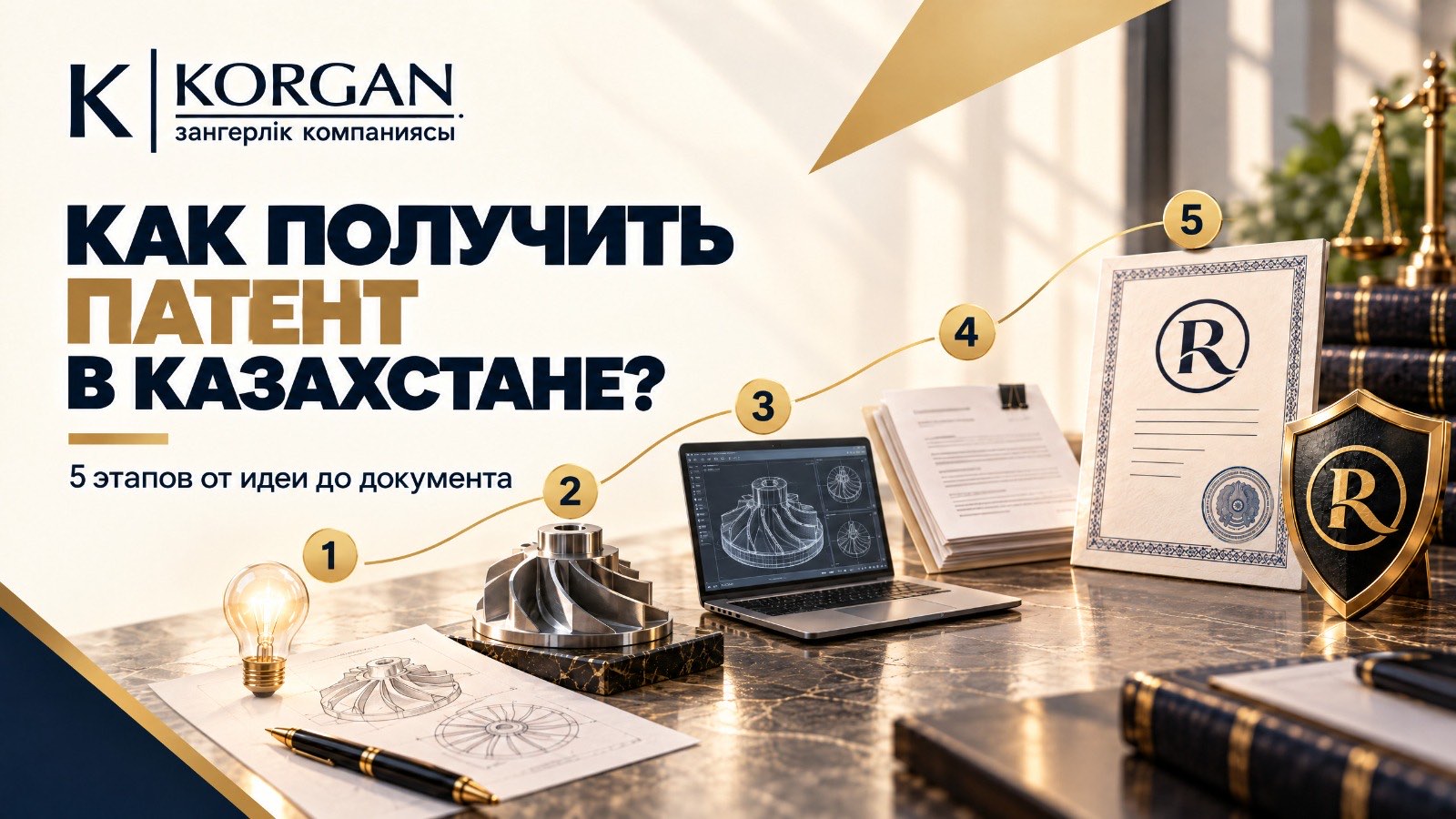
A finished development with no protection is a common situation for manufacturers and IT companies. A competitor sees your product at an exhibition, on social media or at a customer’s site and copies it, and without a patent it is hard to prove you were first. The partners of KORGAN Law Firm explain how to get a patent in Kazakhstan: what happens at each of the five stages, what it costs under the Kazpatent price list, and where applicants most often lose time and money.
The 30-second summary
To get a patent in Kazakhstan, you go through five stages: a patent search, preparing the application, filing with the expert organisation (the National Institute of Intellectual Property, Kazpatent), examination, and registration and grant of the patent. Inventions and industrial designs undergo a formal examination and a substantive examination; a utility model undergoes a single examination with no check of novelty. Official fees for filing, examination and publication for small and medium-sized businesses range from KZT 41,183.71 to KZT 99,870.43. It is best to file before the development is first shown in public: after that, you have six months left to file.
This is general information, not legal advice on your particular case. We checked the provisions against the Patent Law of the Republic of Kazakhstan as amended on 25 January 2026 and the fees against the Kazpatent price list effective from 1 January 2026; links are at the end of the article.
A patent certifies priority, authorship and the exclusive right to the development (Art. 5(2) of the Patent Law): the right belongs to you, not to whoever was quicker to start production.
How to get a patent in Kazakhstan: search and preparing the application
Stage 1. Patent search: checking novelty before filing
Before spending money on an application, it is worth finding out whether the same solution already exists anywhere in the world. An invention must be new, involve an inventive step and be industrially applicable (Art. 6(1)). The prior art includes any information made publicly available anywhere in the world before the priority date. If an equivalent has already been described in publications, there will be no patent, even if you developed your solution independently.
The Patent Law does not make a search a mandatory step before filing; that is the applicant’s decision. But a search shows what exactly is new in your development and how to draft the claims so that they do not repeat what is already known. The expert organisation also carries out an information search during the substantive examination (Art. 22(7)), but by then the application has already been filed and paid for.
Stage 2. Preparing the application: description, claims, drawings
An application must relate to one subject matter or to a group forming a single concept (the unity requirement, Art. 17(1), Art. 18(1), Art. 19(1)). The documents depend on the type of patent:
- invention — a request, a description, claims, an abstract, and drawings and other materials if they are needed to understand the invention (Art. 17(2));
- utility model — a request, a description, claims, drawings and an abstract (Art. 18(2));
- industrial design — a request, a set of images of the product’s appearance and a description (Art. 19(2)).
If a representative handles the application, a power of attorney is required. Proof of payment of the filing fee can be attached to the application or submitted within two months of its receipt; otherwise the application is treated as not filed (Art. 17(2), Art. 18(2), Art. 19(2)).
The key document is the claims. The scope of protection of an invention or utility model is determined by its claims, and that of an industrial design by the combination of its essential features shown in the images of the product (Art. 5(4)). Claims that are too narrow leave a loophole for competitors, while claims that are too broad risk failing examination. The description must disclose the solution fully enough for a specialist to carry it out (Art. 17(2)). A mistake cannot always be fixed later: additional materials that change the essence of the invention are not taken into account when the application is considered (Art. 22(2)).
The request is filed in Kazakh or Russian. Other documents may be submitted in another language, but a translation must be provided within two months of receipt of the application. For a fee, this period can be extended by no more than two months; without a translation, the application is treated as not filed (Art. 16(2)).
Filing, examination and grant of the patent
Stage 3. Filing and formal examination
The application is filed with the expert organisation by a person entitled to the patent: the author, the employer in the case of an employee’s development, or a successor, including under an assignment agreement (Art. 16(1), Art. 10(1)). Priority is established by the filing date (Art. 20(1)), which is set when the request, the description and the drawings are received, or, for an industrial design, the request, the description and an image of the product (Art. 17(3), Art. 18(3), Art. 19(3)). So there is no point in rushing a “raw” package, but delay is risky too: someone may file a similar application first, and once the development has been disclosed publicly, novelty may be lost.
If the first application was filed in another Paris Convention country, priority can be based on it. The application in Kazakhstan must then be filed within twelve months for an invention or utility model and six months for an industrial design (Art. 20(2)).
For an invention, the expert organisation sets the filing date and carries out a formal examination: it checks the documents and whether the proposal falls among the solutions that are not recognised as inventions (Art. 22(1), (1-1)). If the documents have defects, the applicant receives a request and has three months to respond (Art. 22(3)). The applicant is notified of the result. If the proposal is not recognised as an invention (Art. 6(3)), a decision to refuse is issued and the applicant is informed within five working days (Art. 22(5)).
The application and information on its progress are not disclosed to third parties, except in cases provided for by law (Art. 16(3)).
Stage 4. Examination
Invention. The substantive examination is a separate, paid stage. The examiners determine whether the proposal is a protectable technical solution, carry out an information search, and check the unity of the invention and the conditions of patentability (Art. 22(7)). Proof of payment must be submitted within three months of the notice of the formal examination result; otherwise the application is deemed withdrawn.
During the examination, additional materials may be requested, including amended claims, and you have three months to respond (Art. 22(8)). The response is the key working moment of the whole procedure: persuasive arguments and precise amendment of the claims often decide the outcome. For a fee, the response period can be extended by up to six months if the request is filed before it expires (Art. 22(13)).
For inventions on the authorised body’s list, which qualify for favourable patenting conditions, an accelerated examination within six months is available at the applicant’s request (Art. 22(13-1)).
Industrial design. Here, too, there are two stages: a formal examination and a substantive examination, which must be paid for within three months of the notice of the formal examination results (Art. 24(1), (3)).
Utility model. There is a single examination: it covers the documents, the priority date, unity and whether the proposal qualifies as a utility model. Novelty and industrial applicability are not checked, and the patent is granted at the applicant’s own risk and responsibility (Art. 23(1)).
If the application is refused. An objection must be filed within three months of the date the decision was sent, and this pre-trial step is mandatory. The Appeals Board considers an objection within four months for an invention and within two months for a utility model or industrial design (Art. 22(10), Art. 23(3), Art. 24(6), Art. 32(2)). A court claim can be filed after the objection has been considered (Art. 33(1-1)).
Stage 5. Registration and grant of the patent
After a decision to grant the patent, the applicant has three months from the date of the notice to submit proof of payment for preparing the grant and publication. A missed deadline can be restored for a fee within a further three months; otherwise the application is deemed withdrawn (Art. 22(9), Art. 23(2), Art. 24(5)).
The expert organisation then registers the grant in the state register, and the registration details are published in a weekly bulletin (Art. 25(1), (2)). Details of the grant of a patent are published after eighteen months from the filing date for an invention and twelve months for a utility model or industrial design, or earlier at the applicant’s request (Art. 26(1)). The patent is issued to the applicant as a single copy regardless of the number of authors, and an author’s certificate is issued for each author named in the application (Art. 25(3)).
The term runs from the filing date (Art. 5(3)):
- invention — 20 years; for medicines and pesticides whose use requires a permit, it can be extended by no more than 5 years;
- utility model — 5 years, extendable by no more than 3 years;
- industrial design — 10 years, extendable by 5 years at a time, up to 25 years in total.
A patent must be maintained: if maintenance fees are not paid on time, it terminates early (Art. 30(2)).
How much it costs and how long it takes
The law does not guarantee a single time frame for grant: it depends on the type of subject matter, the expert organisation’s workload and how quickly you respond to requests. So go by the stages rather than by promises of “done in N days”. What the law does set are deadlines for the applicant. The main ones for an invention application are:
| Action | Deadline | If missed |
|---|---|---|
| Translation of documents into Kazakh or Russian | 2 months from receipt of the application, extendable for a fee by no more than 2 months (Art. 16(2)) | Application treated as not filed |
| Proof of payment of the filing fee | With the application or within 2 months, extendable for a fee by 2 months (Art. 17(2)) | Application treated as not filed |
| Correcting documents on request | 3 months from the date of the request (Art. 22(3)) | Application deemed withdrawn |
| Paying for substantive examination | 3 months from the notice of the formal examination result (Art. 22(7)) | Application deemed withdrawn |
| Responding to an examiner’s request | 3 months from the date of the request (Art. 22(8)) | Application deemed withdrawn |
| Paying for preparation of the grant and publication | 3 months from the notice of the decision (Art. 22(9)) | A further 3 months to restore for a fee, then the application is deemed withdrawn |
| Objection to a refusal | 3 months from the date the decision was sent (Art. 22(10)) | The deadline has to be restored (Art. 22(13)) |
The deadlines for correcting documents, paying for substantive examination, responding to a request and filing an objection can be restored for a fee if a petition is filed within twelve months of the expiry of the deadline (Art. 22(13)). This rule does not cover the translation or the filing fee. For an industrial design, the petition must be filed within six months (Art. 24(8)).
The costs consist of the expert organisation’s fees and the services of the specialist who prepares the application. Official fees under the Kazpatent price list effective from 1 January 2026 (Order No. 614 of 31 December 2025), including VAT, in tenge (KZT), covering receipt of the application, examination and publication of the grant:
| Subject matter | Small and medium-sized business | Other legal entities | Individuals |
|---|---|---|---|
| Utility model | 41,183.71 | 51,479.64 | 15,443.89 |
| Industrial design (1 variant) | 72,995.56 | 91,244.44 | 27,373.34 |
| Invention (1 independent claim) | 99,870.43 | 124,838.04 | 37,451.41 |
Additional costs may include:
- an information search for an invention or utility model — KZT 64,360.54 for all categories of applicants;
- a surcharge for each independent claim of an invention beyond the first — KZT 44,344.48 for small and medium-sized businesses;
- fees for restoring missed deadlines and extending response periods;
- annual fees to maintain the patent in force;
- the fee of the specialist who drafts the description and claims and handles the examination.
Fees are lower for preferential categories of applicants. Fees may change, so check the current amounts on the Kazpatent website or with our team before filing.
Common applicant mistakes
- Showing the development before filing. If the solution is disclosed at an exhibition, in a presentation or on social media, the application must be filed within six months of disclosure, and the applicant has to prove that fact (Art. 6(4), Art. 7(2), Art. 8(3)). File first, present later.
- Weak or overly narrow claims. The scope of protection is determined by the claims (Art. 5(4)). If they list unnecessary features, a competitor can get around the patent by changing one detail.
- Missed deadlines. The deadlines for the translation (two months), payment for substantive examination (three months from the notice) and responses to an examiner’s requests carry consequences up to withdrawal of the application, and a deadline cannot always be restored and only for a fee.
- Choosing the wrong type of protection. What suits a utility model is sometimes filed as an invention, and vice versa. An industrial design protects appearance, not the operating principle, and a utility model has a shorter term than an invention. The choice affects the term of protection, the cost and the procedure; see What Can Be Patented in Kazakhstan.
- Rights to an employee’s development not documented. Rights to an employee’s development belong to the employer unless a contract says otherwise (Art. 10(2)). The author notifies the employer in writing within a month, and if within four months the employer does not file an application, assign the right or tell the author that the development is being kept secret, the right to the patent passes to the author (Art. 10(4), (7)). Without written agreements, disputes between the employer and the author are possible.
- Skipping the patent search “to save money”. The applicant pays for examination and then learns that an equivalent has already been described, and is refused.
How the KORGAN team helps with patents
KORGAN Law Firm has worked across Kazakhstan since 2014 and supports businesses (LLPs and sole proprietors) on intellectual property. The owner of the firm provides overall management, and each matter is handled by the firm’s partners — lawyers who work on trademarks, copyright and patents. In a patent matter, the team:
- assesses the prospects for protecting the development and helps choose the type of protection: invention, utility model or industrial design;
- organises the patent search and reviews the results with you;
- prepares the description, claims and other application documents and files them with the expert organisation;
- corresponds with the examiners, prepares responses to requests and keeps track of deadlines;
- where necessary, represents the applicant when a decision of the examination is challenged. More about our work on such disputes is on the disputes with government agencies page.
The first consultation is free. Tell us about your development, and we will advise where to start: with a patent search or straight with filing.
Phone and WhatsApp: +7 700 500 05 53
Or message us on WhatsApp.
We checked the provisions against the Patent Law of the Republic of Kazakhstan as amended on 25 January 2026 and the fees against the Kazpatent price list effective from 1 January 2026. For an overview of all types of intellectual property, see our guide to IP in Kazakhstan.
Frequently asked questions
Do I need a patent search before filing?
The Patent Law does not make it a mandatory step, but a search helps assess the novelty of the solution before you pay for examination. The decision is the applicant’s.
How long does it take to get a patent?
The law does not guarantee a single time frame: it depends on the type of subject matter, the expert organisation’s workload and how quickly the applicant responds to requests. For inventions on the authorised body’s list, an accelerated examination within six months is available at the applicant’s request (Art. 22(13-1)).
How much does it cost to get a patent in Kazakhstan?
Official fees for filing, examination and publication for small and medium-sized businesses are KZT 41,183.71 for a utility model, KZT 72,995.56 for an industrial design and KZT 99,870.43 for an invention (Kazpatent price list effective from 1 January 2026, including VAT). The search, additional claims, maintenance of the patent and the specialist’s services are paid separately.
Who can file an application?
A person entitled to the patent: the author, the employer in the case of an employee’s development, or a successor, including under an assignment agreement (Art. 16(1), Art. 10(1)).
In what language is the application filed?
The request is filed in Kazakh or Russian. Other documents may be in another language, but a translation must be provided within two months; otherwise the application is treated as not filed (Art. 16(2)).
What happens if the substantive examination is not paid for?
If proof of payment is not submitted within three months of the notice of the formal examination result, the application is deemed withdrawn (Art. 22(7)). The deadline can be restored for a fee if a petition is filed within twelve months of its expiry (Art. 22(13)).
Can a refusal be challenged?
Yes. An objection is filed within three months and considered by the Appeals Board, and this step is mandatory before going to court (Art. 22(10), Art. 32(2), Art. 33(1-1)). Meeting the deadlines matters, so it is best to consult a specialist as soon as you receive a refusal.
Is the patent valid only in Kazakhstan?
Yes, a Kazakhstan patent is valid in Kazakhstan. For other markets, applications are filed separately or under international procedures. An application for a development created in Kazakhstan can be filed abroad three months after filing with Kazpatent, provided the applicant has not been notified within that time that it contains state secrets, or earlier after a check at the applicant’s request (Art. 37).